Sananga: What It Is, Origin & Traditional Use
Sananga is a traditional Amazonian plant preparation made from the roots or root bark of plants belonging to the Tabernaemontana genus. It is particularly associated with Indigenous communities of the western Amazon, where it has long formed part of hunting, ceremonial and spiritual traditions.
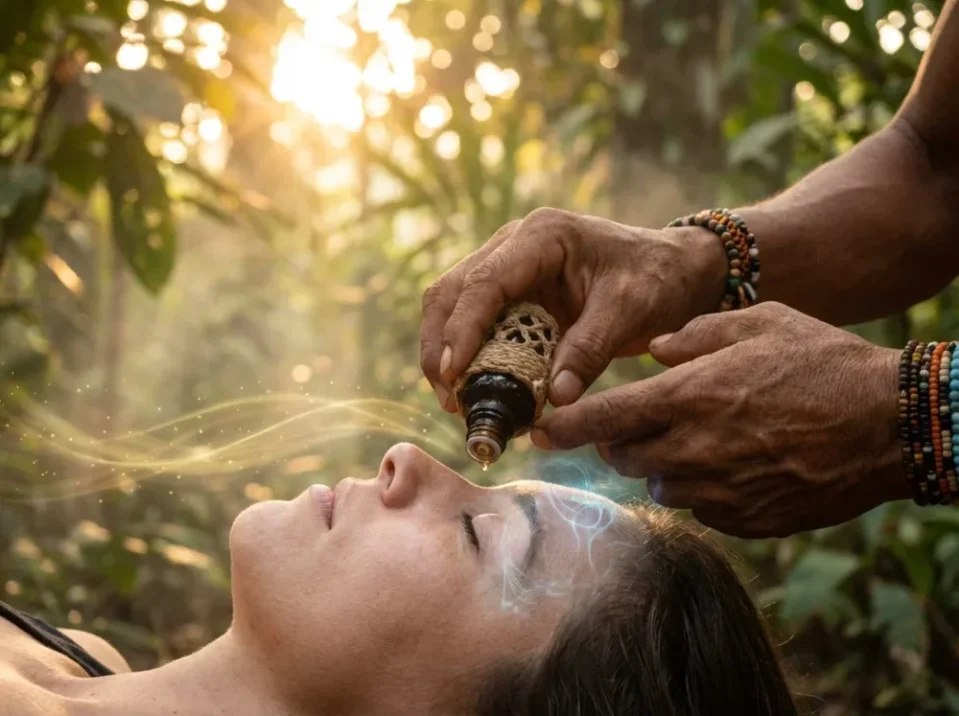
Outside the Amazon, Sananga is best known as a liquid preparation traditionally applied to the eyes. The immediate experience can be intense, usually involving strong stinging and watering of the eyes. In its original cultural context, however, Sananga is not simply about this physical sensation. It is traditionally associated with attention, perception, preparation for hunting and the removal of a condition known in several Amazonian cultures as panema. [2]
Today, Sananga has travelled far beyond Brazil and Peru. Along the way, many modern interpretations have been added to it, some of which blend Amazonian traditions with Western spiritual concepts.
In this guide, we focus on what is known about Sananga's botanical origin, traditional preparation and Indigenous use, while separating those traditions from health claims that are not supported by sufficient clinical evidence.
What Is Sananga Made From?
The name Sananga does not refer to one single plant or one universal recipe.
Preparations known as Sananga are most commonly associated with plants of the Tabernaemontana genus, part of the Apocynaceae family. Traditional use of Tabernaemontana sananho is particularly well documented in scientific and ethnobotanical literature. Tabernaemontana undulata also appears in some ethnographic sources and contemporary traditions in connection with Sananga, although botanical terminology is not consistent across all communities or producers. The plant species used, local name and preparation method can vary according to region and tradition. [1][4]
This is why it is difficult to speak about one single "authentic Sananga".
The Amazon is not one culture, and Sananga does not have one recipe shared across the entire region.
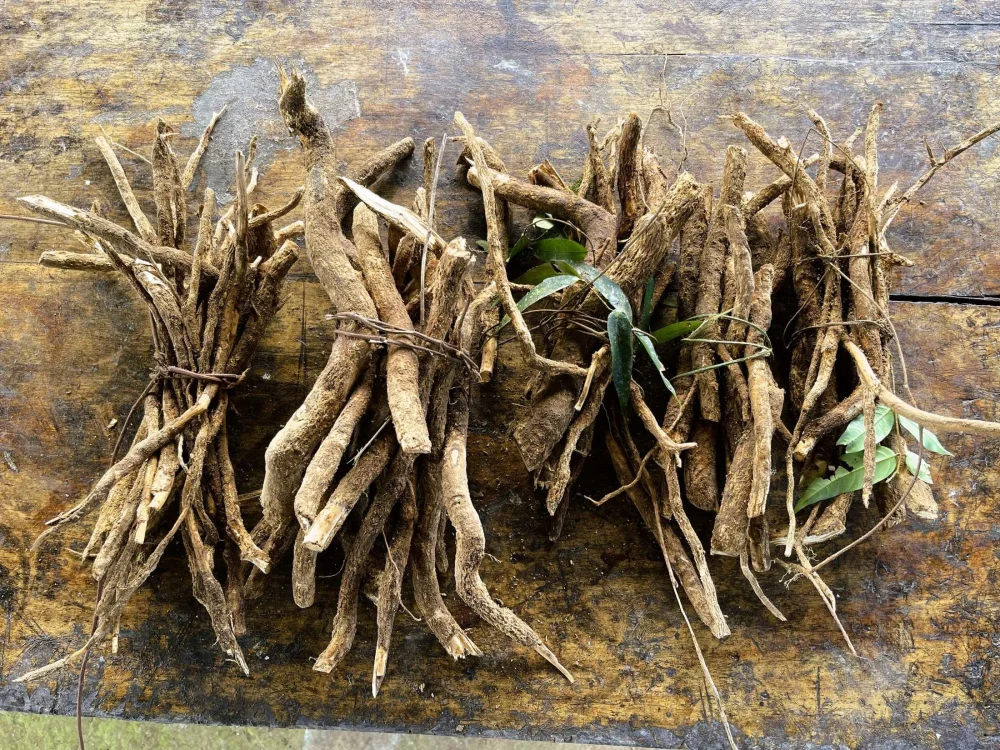
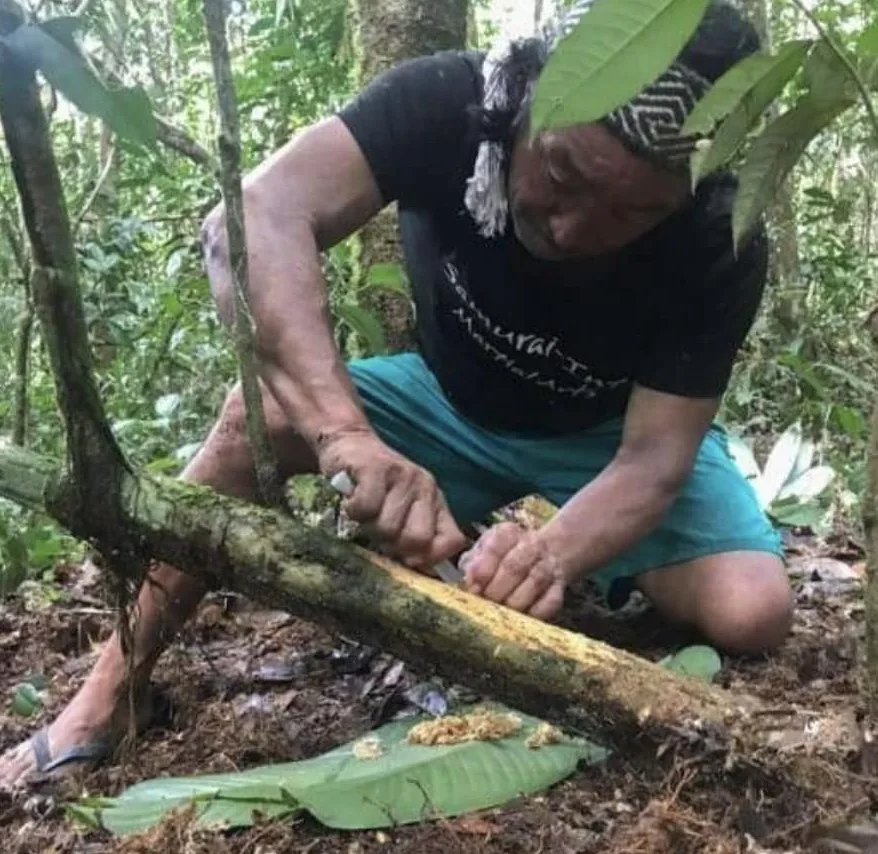
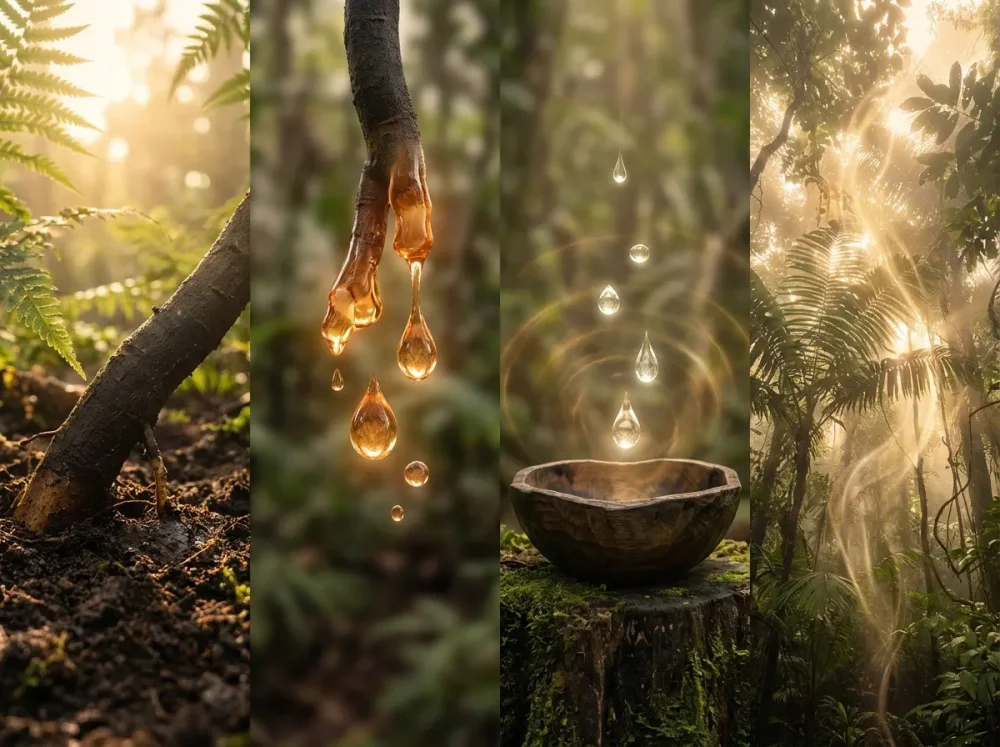
Traditionally, the root or root bark is processed to produce the liquid preparation. Depending on the community and method, the plant material may be scraped, crushed, macerated or otherwise prepared before the liquid is filtered.
The concentration, preparation method and resulting intensity can differ considerably between producers.
Two genuinely traditional Sananga preparations may therefore feel very different from one another.
Sananga in Amazonian Traditions
Sananga belongs to a much wider body of plant knowledge that has been passed between generations within Amazonian communities.
Its use is documented among peoples including the Yawanawá and Huni Kuin, while other communities in the western Amazon, including Nukini, also prepare Sananga today. [2][3][5]
These traditions should not automatically be treated as interchangeable.
What Sananga means within Yawanawá culture may not be identical to the way it is understood among Huni Kuin, Nukini, Kuntanawa or another community.
This distinction matters.
When Amazonian practices arrive in Europe, they are often grouped together under a single "shamanic" narrative. In reality, the Amazon contains many distinct peoples, languages, plant traditions and ways of understanding the world.
Recognising those differences is part of respecting the origin of Sananga.
Sananga and Hunting
One of the most interesting traditional contexts surrounding Sananga is hunting.
Inside dense Amazonian forest, seeing well is not simply a matter of looking into the distance. A hunter needs to notice slight movement between leaves, changes in shadow and the outline of an animal hidden among layers of vegetation.
Anthropological accounts describe Sananga in connection with clear or sharpened perception and preparation for hunting.
Among the Yawanawá, Sananga has been associated with vision and with dispelling laziness or panema. Ethnobotanical research among Huni Kuin communities also documents links between Tabernaemontana sananho, perception and hunting practices. [2][5]
These traditional accounts should not be confused with clinical evidence that Sananga improves eyesight.
They describe a cultural and traditional use, not an established treatment for eye conditions.
What Is Panema?
The word panema is frequently translated online as "negative energy".
That translation is too simple.
Within different Amazonian contexts, panema can refer to bad luck, unsuccessful hunting, diminished vitality or a condition in which a person is unable to function effectively within their surroundings.
Anthropological research also shows how the meaning of panema changed as Amazonian practices moved into urban and neo-shamanic environments, where it gradually acquired a broader spiritual interpretation. [2]
When an Amazonian tradition speaks about Sananga removing panema, translating this automatically as "cleansing negative energy" therefore removes much of the original meaning.
The traditional concept is both more specific and more culturally interesting.
How Is Sananga Traditionally Prepared?
There is no single preparation method used by every community.
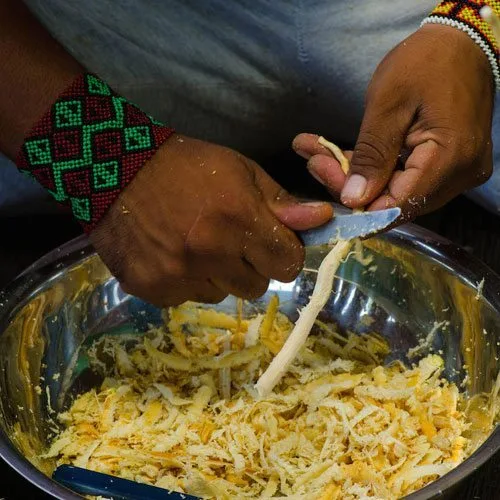
The starting material is generally fresh root or root bark from a Tabernaemontana plant. The material can be scraped, crushed or macerated to obtain a liquid preparation, which is then filtered.
Different contemporary producers may use slightly different techniques. The way the roots are processed can affect the concentration, character and storage requirements of the finished Sananga.
This is why it is useful to know more than the name printed on the bottle.
When choosing Sananga, useful information includes:
-
where it comes from,
-
which community or producer prepared it,
-
which plant was used,
-
how it was prepared,
-
when it was made,
-
how it should be stored.
At La Herba, the origin and intensity of each Sananga are described individually with the product.
Why Does Sananga Sting So Much?
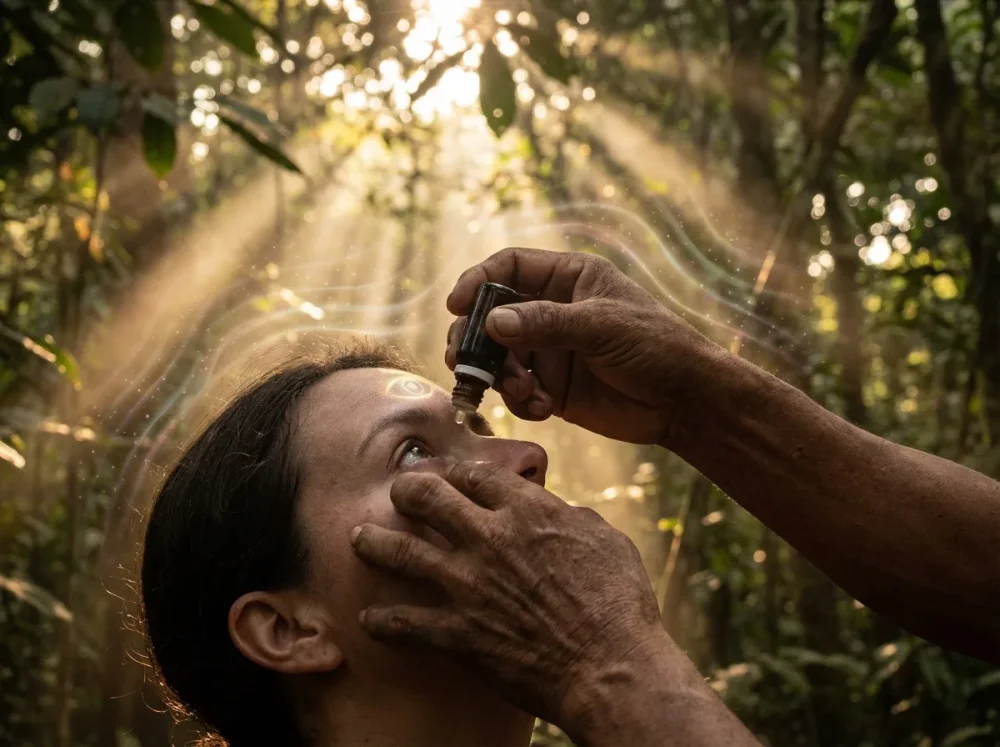
Strong stinging and watering of the eyes are among the most characteristic parts of the traditional Sananga experience.
Anthropological descriptions document an intense burning sensation lasting several minutes, often accompanied by heavy tearing. [2]
Plants of the Tabernaemontana genus contain a complex range of monoterpene indole alkaloids. Scientific research has identified a large number of these compounds across Brazilian Tabernaemontana species. [4][6]
The chemical composition differs between individual species and preparations.
Importantly, the presence of biologically active compounds does not mean that a specific therapeutic effect of Sananga can automatically be assumed.
Research reviewing Tabernaemontana sananho has also highlighted the presence of irritating alkaloids and the need for further investigation into Sananga itself. [1]
A stronger burning sensation is therefore not evidence of better quality.
Nor does stronger Sananga automatically mean a greater health benefit.
What Does Sananga Feel Like?
The most obvious part of the experience is usually physical.
Stinging, burning and watering of the eyes can begin quickly after traditional application. The intensity varies between different preparations and between individuals.
Even the same Sananga may feel different on separate occasions.
After the initial intensity passes, some people describe a period of stillness, concentration or a stronger awareness of the present moment.
These are subjective experiences. They will not necessarily occur for everyone.
This distinction between personal experience and demonstrated effect is important.
Sananga does not have to produce visions, an emotional breakthrough or a spiritual experience. For some people the experience is meaningful and contemplative. For others, it remains primarily an intense physical sensation.
Light, Medium or Força: What Is the Difference?
Sananga is commonly offered in several levels of intensity.
The most familiar descriptions are Light, Medium and Força.
These are not internationally standardised categories. A Medium Sananga from one producer may not have exactly the same intensity as a Medium from another.
Light Sananga
Usually the gentlest of the commonly available options.
It is the most logical place to start for somebody unfamiliar with Sananga or anyone who simply prefers a less intense experience.
Medium Sananga
A medium-strength preparation.
For many people, this offers a balance between the characteristic intensity of Sananga and a more manageable initial sensation.
Força Sananga
Força means "strength" in Portuguese.
Sananga labelled Força is generally prepared as a stronger option and the initial stinging can be considerably more intense.
Stronger does not automatically mean better.
Origin, preparation method, freshness and transparency about who made the product are more useful indicators than intensity alone.
How to Choose Sananga
If you are looking at Sananga for the first time, choosing the strongest bottle is not necessarily the best approach.
There are more useful questions to ask.
Where does it come from?
A transparent seller should be able to identify at least the region and, where possible, the community or producer connected with the Sananga.
When was it prepared?
Sananga is a liquid botanical preparation, so production date and freshness are meaningful information.
How was it prepared?
Different methods can produce preparations with different characteristics and storage requirements.
How strong is it?
A beginner does not need to start with Força.
Intensity is not the same thing as authenticity or quality.
How should it be stored?
Always follow the storage information provided for the specific product. Preparation methods can influence shelf life and storage requirements.
Sananga and Rapé: What Is the Difference?
Sananga and Rapé are often encountered within the same contemporary ceremonial environment, but they are completely different Amazonian preparations.
Sananga is a liquid botanical preparation primarily associated with plants of the Tabernaemontana genus.
Rapé is a very fine Amazonian plant powder traditionally administered using a Kuripe or Tepi.
In some Indigenous and contemporary ceremonial settings, the two may appear within the same wider practice, but their composition, preparation and traditional use are different.
Anthropological research among the Yawanawá documents Sananga and Rapé alongside other preparations within the wider category sometimes translated as "forest medicines". [3]
For someone beginning to explore Amazonian traditions, it therefore makes little sense to think of Sananga as a liquid version of Rapé.
It is not.
There are, however, interesting points of connection. Some Rapé blends use plant material from Tabernaemontana sananho, the same species strongly associated with traditional Sananga preparation.
What Does Science Say About Sananga?
This question requires an important distinction between three different areas:
-
traditional use of Sananga,
-
chemical and pharmacological research into Tabernaemontana plants,
-
clinical evidence concerning finished Sananga preparations used on the eyes.
The first two are substantially better documented than the third.
Researchers have identified numerous indole alkaloids in Tabernaemontana sananho and other species within the genus. Laboratory studies continue to investigate the biological properties of individual compounds and plant extracts. [4][6]
This research is scientifically interesting, but it does not demonstrate that Sananga treats a particular eye condition or other illness.
A scientific review specifically examining the ethnobotany of Tabernaemontana sananho and Sananga concluded that further research is needed to properly assess its properties and rational use. [1]
For this reason, we do not consider it accurate to claim that Sananga treats cataracts, glaucoma, infections, insomnia, anxiety or other medical conditions.
Traditional knowledge and clinical medicine are different categories of evidence.
Both can be discussed, but they should not be presented as if they were the same thing.
Safety and a Responsible Approach
The eye is a sensitive organ.
An intense short-term sensation traditionally associated with Sananga should not be used as a reason to dismiss persistent or unusual symptoms.
Sananga is not an approved medicine or medical device and should not replace professional eye care.
Anyone with an eye condition or injury, anyone who has recently undergone eye surgery, or anyone uncertain about ocular safety should seek advice from a qualified eye-care professional.
Persistent pain, marked redness, changes in vision or any other unusual reaction should not simply be interpreted as "cleansing".
Always follow the storage, shelf-life and handling information supplied with the individual product.
Sananga Without Unnecessary Mystification
Sananga does not need exaggerated claims to be interesting.
Its real story is already remarkable.
It has a specific botanical background, belongs to living Amazonian traditions and is connected with hunting, perception, ceremony and cultural concepts such as panema.
As Sananga has spread into Europe and North America, concepts such as chakras, the pineal gland, "third-eye activation" and energetic detoxification have frequently been added to the discussion.
These ideas may form part of an individual's contemporary spiritual interpretation, but they should not automatically be presented as part of the original Amazonian tradition.
For us, more useful questions are simple:
Who prepared the Sananga?
Where did it come from?
Which plant was used?
How does the community that prepared it understand its place within their own tradition?
Those details tell us far more than dramatic promises about what Sananga is supposed to do.
Sananga at La Herba
At La Herba, we choose Sananga with particular attention to origin, freshness and the people connected with its preparation.
Our Sananga selection includes preparations from the Brazilian state of Acre, including Sananga associated with Nukini and Kuntanawa communities.
Different strengths are available so that intensity does not become the only criterion for choosing between them.
We provide information about origin, strength and the characteristics of each individual Sananga directly with the product.
If you are deciding between Light, Medium and Força, start with the product description rather than assuming that the strongest option is automatically the best one.
Frequently Asked Questions About Sananga
What is Sananga?
Sananga is a traditional Amazonian botanical preparation most commonly associated with the roots or root bark of plants belonging to the Tabernaemontana genus.
Its traditional meaning and use differ between Amazonian communities. [1][2]
Which plant is Sananga made from?
There is no single universal species.
Tabernaemontana sananho is particularly well documented in scientific and ethnobotanical literature in connection with Sananga and related Indigenous plant traditions. Tabernaemontana undulata also appears in some ethnographic and contemporary accounts, although botanical terminology is not consistent across all communities and producers. [1][4]
Why does Sananga sting?
The characteristic intense sensation is well documented in traditional and anthropological descriptions of Sananga.
Plants within the Tabernaemontana genus contain numerous indole alkaloids, and research into T. sananho also describes irritating compounds. [1][6]
A stronger sensation should not be interpreted as evidence of greater quality or effectiveness.
Does Sananga improve eyesight?
Clearer or sharpened perception in connection with hunting forms part of traditional accounts from some Amazonian communities.
There is currently insufficient clinical evidence to claim that Sananga treats visual impairment or eye disease.
What does Força mean?
Força means "strength" in Portuguese.
Força Sananga is generally an intentionally stronger preparation. Light, Medium and Força are not standardised scientific categories, so intensity can differ between producers.
Is the strongest Sananga the best?
No.
Intensity is only one characteristic. Origin, preparation, freshness and transparency about the producer are equally important when assessing a Sananga.
Is Sananga psychedelic?
Sananga is not traditionally used as a classical psychedelic and the typical Sananga experience is not comparable to a psychedelic state.
Tabernaemontana plants do contain a complex range of alkaloids, however, so overly simplistic claims about the chemistry of Sananga should be avoided. [4][6]
Are Sananga and Rapé traditionally used together?
They can appear within the same wider ceremonial context, both in Amazonian traditions and in contemporary practice.
They are nevertheless different preparations with different ingredients, methods of preparation and cultural roles. [3]
Final Thoughts
Sananga becomes more interesting when we look at its actual origins rather than reducing it to a list of promised effects.
It is a traditional Amazonian botanical preparation with a specific plant background, distinct methods of preparation and a cultural context that varies between communities.
Those differences are worth understanding.
If you are choosing Sananga, look first at its origin, producer, preparation and intensity.
Stronger does not necessarily mean better.
To continue exploring Amazonian traditions, you can also read our complete guide to Rapé, or browse our current Sananga collection.
Haux e muita alegria!
Sources and Scientific Literature
-
Robert, A. P., Sieben, P. G., de Lima, A. (2023). Ethnobotanical of the plant Tabernaemontana sananho Ruiz & Pavon (Apocynaceae) - Integrative Review. Revista Fitos, 17(3), 445-459. DOI: 10.32712/2446-4775.2023.1432.
-
Meneses, G. P. (2018). Medicinas da floresta: conexões e conflitos cosmo-ontológicos. Horizontes Antropológicos, 24(51), 229-258. DOI: 10.1590/S0104-71832018000200009.
-
Platero, L. D., de Rose, I. S. (2022). "Forest Medicines," Kinship Alliances, and Equivocations in the Contemporary Dialogues between Santo Daime and the Yawanawá. Anthropology of Consciousness, 33(2), 279-306. DOI: 10.1111/anoc.12160.
-
Luzuriaga-Quichimbo, C. X., Ruiz-Téllez, T., Blanco-Salas, J., Cerón Martínez, C. E. (2018). Scientific validation of the traditional knowledge of Sikta (Tabernaemontana sananho, Apocynaceae) in the Canelo-Kichwa Amazonian community. Mediterranean Botany, 39(2), 183-191. DOI: 10.5209/MBOT.60073.
-
Penedo, T. S. de A. P., Quinet, A., Haverroth, M., Peixoto, A. L. (2023). The singularity of the medicinal knowledge of the Huni Kuĩ people from the western Brazilian Amazon. Ethnobotany Research and Applications, 25, 1-107. DOI: 10.32859/era.25.38.1-107.
-
Nogueira, T. S. R. et al. (2024). An update review on monoterpene indole alkaloids and biological activities of Tabernaemontana species occurring in Brazil. Journal of Ethnopharmacology. DOI: 10.1016/j.jep.2024.117921.
Disclaimer
Sananga is not an approved or registered medicine or medical device and is not a substitute for professional medical or eye care.
The information in this article is provided primarily to describe the historical, ethnobotanical and traditional context of Sananga. Traditional use, laboratory research into a plant or studies of isolated plant compounds do not establish effectiveness for any particular medical condition.
La Herba products within this category are offered as ethnobotanical specimens for ethnographic, historical and educational purposes. The information provided does not constitute medical advice or a recommendation to diagnose, treat, cure or prevent any condition.